


Electronics Basics Course
55.000
Electronics Basics Course
Electronics Basics Course for Beginners | Electronics from Zero
Launch into the world of electronics step by step! An intensive 10-hour practical course (2 hours daily for 5 days) that takes you from scratch to building real electronic circuits.
What will you learn?
-
Understanding basic electronic components (Resistors, Capacitors, Transistors)
-
Reading schematics and electronic symbols easily
-
Using the Breadboard for circuit connections
-
Measuring electrical values using the Multimeter
-
Implementing an integrated practical project (Alarm or Lighting circuit)
Course Features:
✅ For complete beginners – No prior experience needed
✅ 90% hands-on training from day one
✅ Online training via Zoom or in-person attendance options
✅ Private session (one-on-one) or shared class (group)
✅ Certified certificate upon course completion
Suitable for:
School and university students, electronics hobbyists, teachers, and tech entrepreneurs.
Turn your curiosity into a practical skill – Register now and build your first electronic circuit with your own hands! 🔧⚡
Electronics Basics Course
Electronics Basics Course for Beginners | Electronics from Zero
Course Overview
Your perfect opportunity to launch into the world of electronics from scratch! This comprehensive introductory course is your gateway to understanding the language spoken by all electronic devices around you. Electronics is no longer a scientific luxury but has become an essential skill for engineering students, technology enthusiasts, and innovators alike. In this practical workshop, we will guide you step by step from being just a device user to an innovator capable of understanding and designing your own circuits.
:Detailed Learning Objectives
Module 1: Electronics Fundamentals and Components
-
Understanding the nature of electricity: Current, Voltage, and Resistance – and their relationship through the simple Ohm’s Law.
-
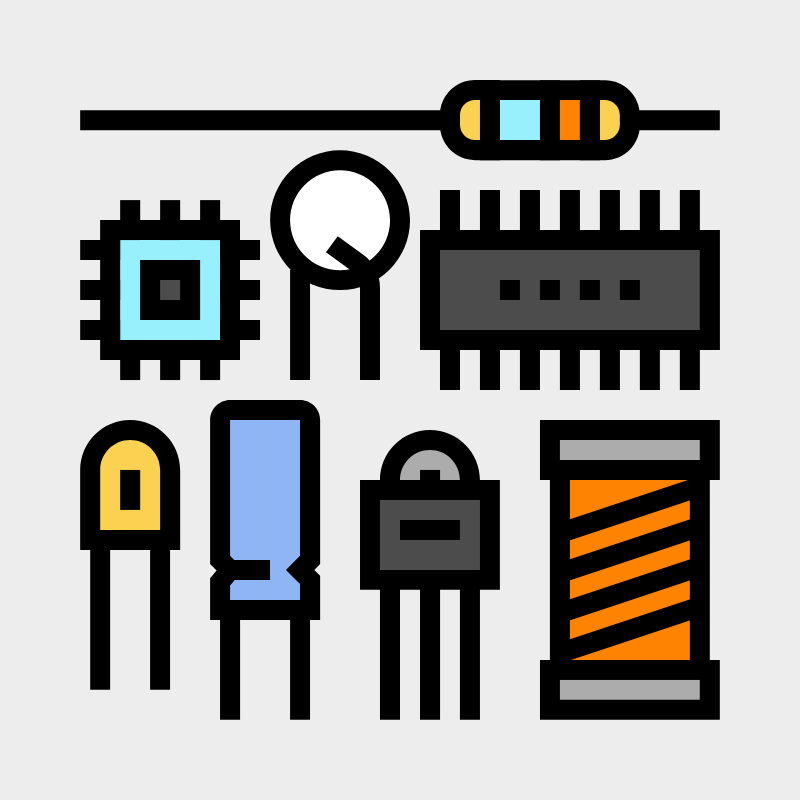
Identifying basic components: Resistors, Capacitors, and Transistors – their function, shapes, and how to read their values.
-
Distinguishing between active and passive components and understanding the role of each in an electrical circuit.
- We recommend checking out the Electronics Encyclopedia from All About Circuits (valuable external link for deeper learning).
Module 2: Reading and Understanding Electronic Schematics
-
How to read the secret map: Decoding symbols and notations of schematic diagrams with ease.
-
Recognizing standardized symbols for resistors, LEDs, batteries, and switches.
-
Tracing the current path in the circuit and understanding signal flow from source to load.
-
The DigiKey Electronic Symbols Library (external link) will help you learn more.
Module 3: Practical Application and Circuit Building
-
Using the Breadboard: The magical place to test your circuits without soldering.
-
Connecting simple circuits: Operating an LED with an appropriate resistor – your first light made by your own hands!
-
Series and Parallel connections: The difference between them and their effect on voltage and current.
-
Measuring values: Learning to use the Multimeter to measure voltage, current, and resistance.
Module 4: Integrated Practical Project
You will implement a mini graduation project integrating everything you have learned, such as:
-
A simple light-activated alarm circuit.
-
An LED lighting controller with moving effects.
This project will be the beginning of your work and your starting point for innovating your personal projects.
Target Audience
This course is perfect for:
✅ Students: In high school and university levels (Engineering, Physics, Science) who need practical understanding for academic projects.
✅ Hobbyists and Beginners: Those with scientific curiosity who want to decode the electronic devices around them.
✅ Teachers and Trainers: Those wishing to establish a practical curriculum for their students.
✅ Tech Entrepreneurs: Those who want to understand the technical aspect of their project ideas before implementation.
✅ Anyone wishing to build a practical skill that opens horizons for creativity and innovation.
Course Requirements
-
Level: Complete beginner – no previous background in electronics or programming is required.
-
Tools: A regular computer (optional) – the main focus is on practical connections.
-
Readiness to experiment: All you need is a love for exploration!
Course Features
🔹 Immediate practical application: No long theoretical memorization – you start connecting from day one.
🔹 Specialized instructor: With practical experience in circuit design and project implementation.
🔹 Facilitated methodology: We explain concepts in simple language with examples from daily life.
🔹 Continuous support: You can ask your questions even after the course ends.
🔹 Gateway to advanced specializations: This course is the first step before advancing to the Arduino Programming Course, the IoT Course, or even PCB Design Course (internal links to your other training pathways).
What Will You Gain After This Course?
✅ Real understanding: Electronics is no longer a mysterious science, but rather a language you comprehend.
✅ High confidence: You will be able to open any simple device and understand its basic components.
✅ Practical project: You will build an integrated electronic circuit with your own hands.
✅ Certified certificate: Added to your professional and academic portfolio.
✅ Solid foundation: To specialize in any electronic or software field later on.
🚀 Do not hesitate to invest your time in the skill of the future. Electronics is no longer a narrow specialization, but has become the language of the modern age. Register now and begin the thousand-mile journey with a practical step
Related products

Web Programming Course (HTML/CSS) (5-Day Course)
Web Programming Course (HTML/CSS) (5-Day Course)
⚡ *HTML/CSS Course – 5 Days*
• Learn to build websites from scratch • Hands-on HTML5 + CSS3 • Responsive design for mobile and desktop • Full final project + certificate
🎯 For beginners and programming students 📅 5 days | 💻 Interactive online 🌟 Limited seats – Register now!
C++ Programming Course
C++ Programming Course
Launch into the world of programming with the comprehensive C++ course for beginners! In just 5 days (10 hours), you will learn the language basics, set up the programming environment, write commands, and perform arithmetic operations and functions. You will build simple practical applications and acquire the essential skills to begin your programming journey.
Course Features:
-
Suitable for absolute beginners
-
Direct hands-on remote training
-
Accredited certificate upon completion
-
Individual or group training options
Register now and start your programming journey!
Raspberry Pi Programming Course
Raspberry Pi Course | Programming Electronics Projects
Learn Raspberry Pi programming with Python in just 5 days! A specialized hands-on course covering board setup, GPIO port programming, and controlling cameras and sensors to implement smart electronic projects.
What will you learn?
-
Identifying Raspberry Pi components and installing the operating system
-
Programming electronic components using Python and the RPi.GPIO library
-
Implementing practical projects (camera, audio, sensors)
-
Connecting projects to real-world applications in IoT and smart systems
Course Features:
✅ Exclusive electronics toolkit for each participant ✅ 10 hours of direct hands-on training ✅ Accredited certificate upon completion ✅ Online or in-person training option ✅ Applied projects from day one
Prerequisites: Basic knowledge of Python and electronics.
Suitable for: Engineering students, IoT developers, electronics enthusiasts, and makers.
Register now and start building your smart projects!

Arduino Robotics Programming Course
Arduino Robotics Programming Course
Arduino Robotics Programming Course | Arduino Robotics
Learn to build and program robots from scratch! An intensive 5-day hands-on course covering chassis design, motor assembly, and sensor programming using Arduino C language.
What will you learn?
-
Understanding robot components and selecting the right parts
-
Assembling mechanical structures and connecting motors
-
Programming precise control of robot movement
-
Programming sensors (distance, tracking, collision)
-
Implementing a practical autonomous robot project
Course Features:
✅ Complete robotics toolkit for each participant ✅ 10 hours of direct hands-on training ✅ Accredited certificate in robotics programming ✅ Online or in-person training ✅ Applied practical graduation project
Prerequisites: Basic knowledge of Arduino C and electronics.
Suitable for: Engineering students, robotics enthusiasts, makers, and technical educators.
Register now and build your first robot! 🤖